
Blog
The Legal and Financial Risk of Undervaluing an Estate's Tool Collection
Labeling a decedent's shop equipment as "junk" instead of documenting its value can trigger an IRS estate-tax penalty, expose the executor to a beneficiary lawsuit, and leave the family unable to collect on an insurance claim. Here is what actually happens when tools and machinery go unappraised.
A Bridgeport mill, a Snap-on roll cabinet full of sockets, a half-century of accumulated hand tools in a garage workshop: families settling an estate often look at this kind of property and see clutter. Grease, rust, and dust read as worthless. So the executor writes "shop tools and miscellaneous" on the inventory, assigns a round number like $500, and moves on to the house and the brokerage accounts.
That shortcut can turn into three separate legal problems: an IRS challenge to the estate tax return, a fiduciary-duty claim from beneficiaries, and an insurance claim the family cannot win because they never documented what they had. None of these risks require the tools to be worth a fortune. They require only that the reported value be wrong enough, or undocumented enough, to matter.
The "Junk" Label Is the Real Risk, Not the Grease and Rust
The mistake at the center of almost every one of these cases is the same: someone assumed that used tools are worthless because they look used. Collector-grade hand tools (certain Stanley planes, Starrett precision instruments, vintage machinist tool chests) regularly sell for hundreds or thousands of dollars apiece. Commercial and industrial equipment like a Bridgeport mill, a name-brand lathe, a plasma table, or a quality welder can carry real resale value even well into its working life.
A documented tool appraisal for estate and probate exists precisely to separate the genuinely worthless from the genuinely valuable, with a written, defensible record of the difference. Skipping that step does not make the value go away. It just means nobody can prove what the value actually was, which is the problem that drives every risk below.
IRS Challenge Risk on the Estate Tax Return
For federal estate tax purposes, property is generally reported at its fair market value on the date of death. If the IRS later determines that shop equipment or a tool collection was worth substantially more than what the estate reported, the estate can face an accuracy-related penalty on top of the additional tax owed.
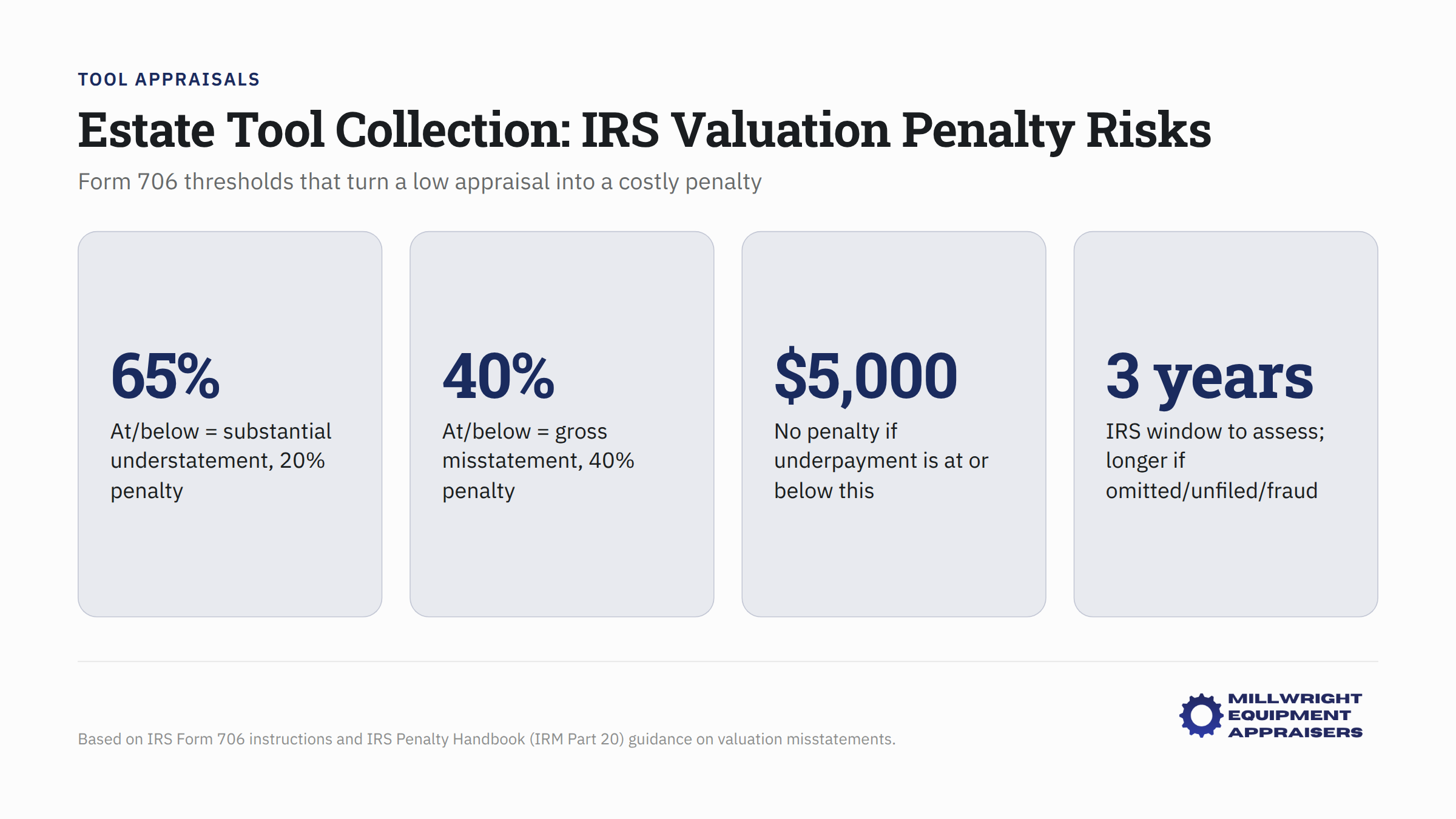
The Form 706 instructions lay out the thresholds in plain terms. A reported value at or below 65% of the corrected value is a substantial valuation understatement, which can draw a penalty of 20% of the resulting underpayment. A reported value at or below 40% of the corrected value is a gross valuation misstatement, which raises the penalty to 40% of the underpayment. No penalty applies if the underpayment attributable to the error is $5,000 or less.
Example: An estate lists a workshop's contents, including a Bridgeport mill, a TIG welder, and a tool chest, at $4,000. An IRS examiner later determines the actual date-of-death value was $15,000. Because $4,000 is roughly 27% of $15,000, well under the 40% line, the estate is in gross-misstatement territory, and the penalty calculation starts from there if the resulting tax underpayment exceeds $5,000.
The IRS generally has 3 years from the filing date to assess additional tax, though a substantial omission of gross estate assets can extend that window, and an unfiled or fraudulent return has no limitations period at all, as addressed in the IRS Penalty Handbook guidance on valuation misstatements. A low number on the inventory does not quietly become final just because a few years pass.
Watch out: A penalty is not automatic just because a number turns out to be low. The IRS instructions also weigh whether the estate acted in good faith, which is exactly what a contemporaneous, documented appraisal is built to demonstrate.
Executor Fiduciary Liability When Tools Are Sold Short or Given Away
An executor is a fiduciary, which means the law expects more than good intentions. The role generally includes identifying estate property, valuing it reasonably, and distributing it according to the will and applicable probate law. When shop equipment gets labeled "junk," sold to a neighbor for pocket change, or handed to one family member without any accounting, that expectation can break down fast.
Beneficiaries who discover that a Bridgeport mill, a welding rig, or a serious hand tool collection was undervalued or quietly disposed of have real options in probate court. Depending on the state, they can petition for a corrected inventory, demand a formal accounting of estate property, or ask the court to surcharge the executor, meaning the executor becomes personally liable for the shortfall between what the tools were actually worth and what the estate received. In more serious cases, courts can remove an executor entirely.
The American Bar Association's guidance for individual executors and trustees specifically recommends professional appraisal of tangible personal property, noting that it serves both tax reporting and the separate question of whether insurance coverage is adequate. That distinction matters here: the point is not just avoiding an IRS fight, it is giving every beneficiary a number they can trust, backed by someone other than the executor's own guess.
Federal rules add another layer of pressure. Regulations governing who can be held liable for estate tax identify beneficiaries who receive estate property as potentially liable to the extent of that property's value, as described in the federal regulation on transferee liability for estate tax. An executor who distributes a valuable tool collection before reserving funds for taxes and creditor claims can create exposure for themselves and for the beneficiary who received it.
Key takeaway: The difference between a defensible valuation judgment and a problem is documentation. An executor who hired a qualified appraiser and can produce a written report is in a fundamentally different position than one who wrote a number on a legal pad. Our guide for executors handling tool appraisals walks through how that documentation should be built during probate, not after a dispute starts.
Underinsurance Exposure Between Death and Distribution
The period between a death and final distribution of the estate is exactly when a shop full of tools is most vulnerable. The property often sits in a garage or outbuilding that nobody is actively watching, sometimes for months, while probate works through the courts. A fire, a break-in, or water damage during that window is not a hypothetical.
Without a documented appraisal, the estate typically has no way to prove the tool collection existed, what condition it was in, or what it was worth before the loss. Insurance claims generally place the burden of proof on the insured party to demonstrate the loss, not on the insurer to disprove it, a principle well established in how business and personal property claims are evaluated. An inventory that says "shop tools, $500" gives an adjuster almost nothing to work with, and very little reason to pay more.
Commercial and homeowners policies covering shop equipment also frequently include coinsurance requirements, commonly set at 80% or 90% of the property's value. Carry less coverage than the required percentage and the insurer can reduce even a partial-loss payment proportionally, a mechanic explained in general coverage guidance on commercial property insurance. A family that insured the shop based on a guessed, deflated value is often coinsured against its own underestimate.
Example: A workshop's equipment is genuinely worth $80,000, but the estate insured it for $40,000 under a policy with an 80% coinsurance clause. The required coverage was $64,000. On a $20,000 covered loss, the shortfall in coverage can reduce the payout well below the full claimed amount, before the deductible is even applied.
This is also where an insurance appraisal and an estate appraisal serve closely related but distinct purposes. If the tools are staying in the family rather than being sold, it is worth asking whether ordinary homeowners coverage is enough, or whether the collection needs its own scheduled personal property rider once distribution is complete.
One Appraisal, Several Different Purposes
A single written appraisal rarely answers every question an estate will face, because "value" means something different depending on why it is being asked. The same Bridgeport mill can have a different number attached to it for tax purposes, for dividing the estate fairly among siblings, for a quick liquidation sale, and for an insurance policy.
The following table shows how those purposes diverge:
| Purpose | What the valuation needs to answer |
|---|---|
| Federal estate tax | What was the fair market value on the date of death? |
| Probate inventory and distribution | What value fairly represents the asset when dividing the estate among beneficiaries? |
| Liquidation or quick sale | What would a realistic buyer actually pay, net of sale costs? |
| Insurance coverage | What valuation basis and limit does the policy require to repair or replace the item? |
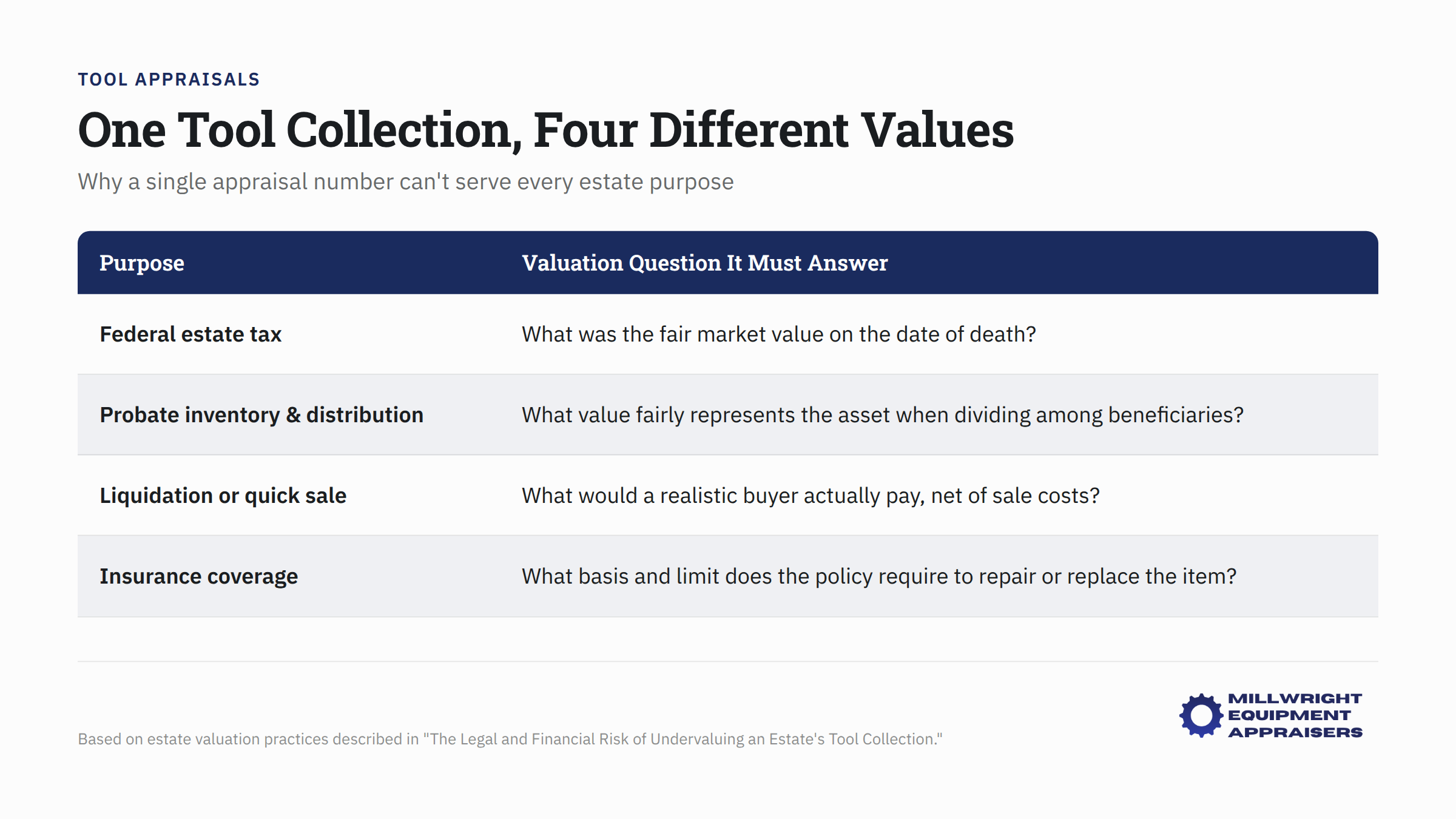
A single number, especially a nominal guess, cannot satisfy all four. That is why a qualified appraisal engagement is scoped to the estate's actual purpose before it begins. Fees for this kind of work are quoted as a fixed amount after the appraiser understands the scope, the number of items, and the intended use, never billed hourly and never based on what the tools turn out to be worth.
Protecting the Estate Starts With the Inventory, Not the Dispute
The pattern behind IRS penalties, executor surcharge claims, and denied insurance claims is the same: a family treated a real shop's worth of equipment as an afterthought, and nobody wrote down what it actually was or what it was worth. By the time a dispute or a loss happens, it is too late to go back and document the Bridgeport mill, the welding equipment, or the tool chest as it existed before.
An appraisal completed during probate, before anything is sold, distributed, or lost, gives the executor a defensible number for the IRS, a fair basis for dividing property among beneficiaries, and the documentation an insurer actually needs to pay a claim. If a family is settling an estate that includes a serious tool collection or shop equipment, getting that documentation in place early is far cheaper than defending a valuation after the fact.
This article is provided for general informational purposes only and does not constitute legal, tax, or financial advice. Readers should consult a qualified attorney or CPA regarding their specific circumstances.