
Blog
Tool Appraisal for Divorce Guide: Valuing a Shop or Garage for Equitable Division
When a marriage ends, a contractor's truck full of equipment or a garage lined with tools has to be valued fairly for the split. This guide explains how tool appraisals for divorce work, what standard of value applies, and how to get a defensible number both sides can trust.
Divorce forces couples to put a dollar figure on things that were never meant to be priced. A truck full of trade tools, a workshop built up over 20 years, or a garage stocked with power tools and diagnostic equipment all become line items on a marital balance sheet. If you or your spouse owns a meaningful tool collection, getting that valuation right matters as much as valuing the house or the retirement account.
This guide walks through how a tool appraisal supports divorce settlement or litigation: why tools count as property subject to division, what standard of value applies, why the valuation date matters, and what a defensible, USPAP-compliant report actually looks like.
Are Tools Marital Property in a Divorce?
In most cases, yes. Tools and equipment acquired during the marriage are generally treated as marital or community property, subject to division regardless of whose name is on the receipt or whose hands use them daily. Tools owned before the marriage are typically treated differently, though the exact rule depends on the state and on how the asset was used or commingled during the marriage, as noted in general family law guidance on tools and equipment in divorce.
Cornell Law School's Wex Legal Dictionary defines equitable distribution as the legal principle, used in most U.S. states, that marital property should be divided fairly between spouses, though not necessarily equally. A smaller number of states instead follow community property rules, where most assets acquired during the marriage are split 50/50 regardless of whose income purchased them. Common law property states, by contrast, generally look at whose name is on the title or purchase record. Which framework applies to your case changes how tools get divided, but it doesn't change how they get valued: an appraiser's job is to establish fair market value, not to decide who keeps what.
Watch out: Don't assume a tool collection is too small to matter. A contractor's inventory of power tools, diagnostic scanners, and specialty equipment can easily run into the tens of thousands of dollars, and courts have no patience for guesswork on either side.
What Standard of Value Applies to Tools in a Divorce?
Most courts ask for fair market value, the price a willing buyer would pay a willing seller in the used equipment market, with neither party under pressure to act. That's the default standard our appraisers use unless an attorney or the court specifies something else.
That said, the exact standard can vary by jurisdiction. Some courts want net value after accounting for liens or business debt tied to the equipment; others want a straightforward market value figure to include on the asset schedule. Your attorney, not the appraiser, should confirm which standard the court expects before the engagement begins. Getting this detail wrong can mean redoing the report, which costs time and money neither spouse wants to spend twice.
Picking the Right Valuation Date
Timing affects the number as much as condition does. A truck-mounted air compressor bought two years ago is worth more than the same unit valued today, and courts are specific about which date they want reflected in the report.
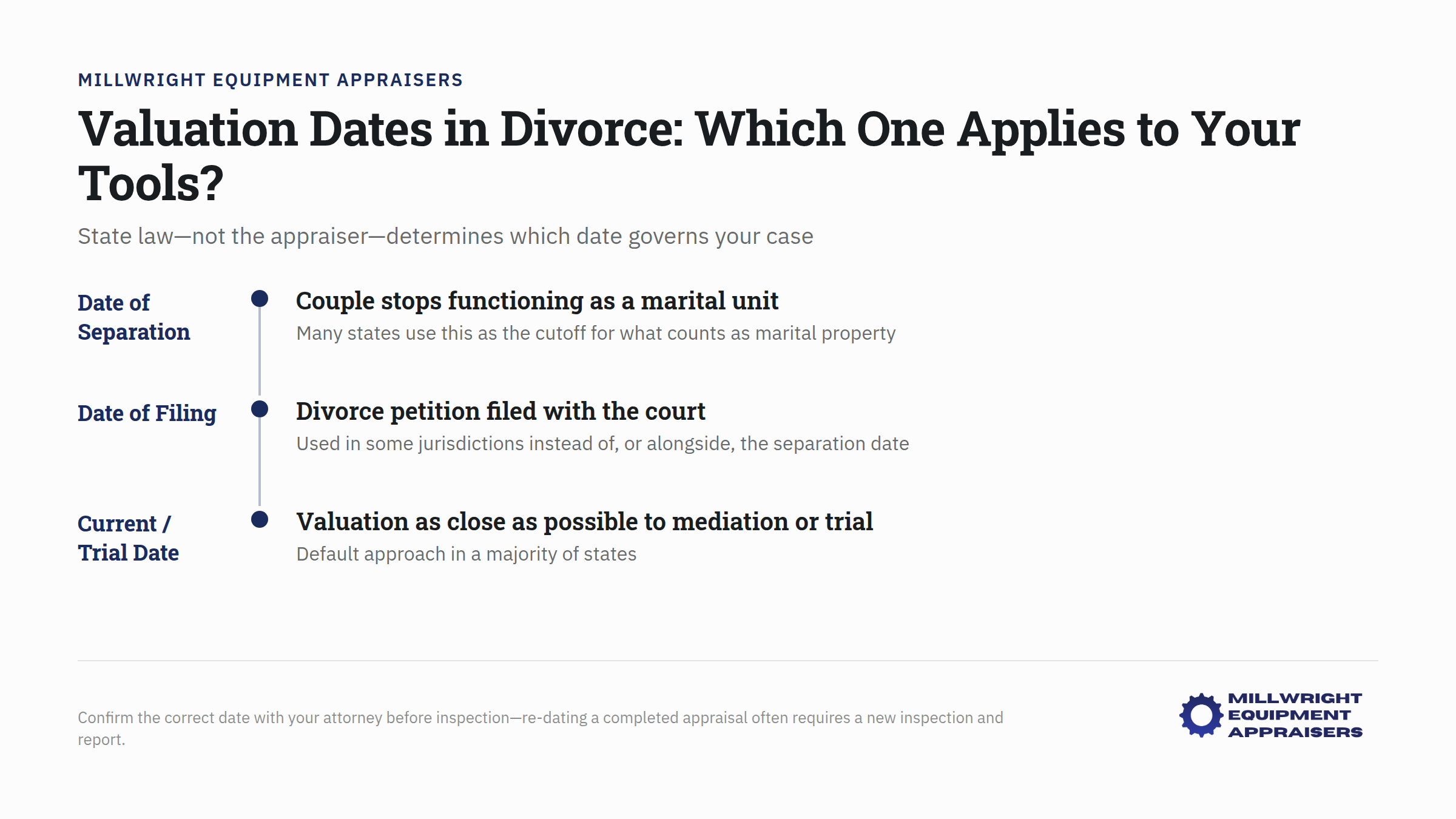
Common valuation dates used in divorce proceedings include:
- Date of separation: The day the couple stopped functioning as a marital unit, used by many states as the cutoff for what counts as marital property.
- Date of filing: The day the divorce petition was filed with the court, used in some jurisdictions instead of or alongside the separation date.
- Current date or trial date: Used by courts that want a valuation as close as possible to the mediation session or the trial itself.
A majority of states default toward a date close to trial or mediation, though several also require the date of separation to be considered for certain assets, according to general family-law valuation guidance. The correct date is a legal question, not an appraisal question. Confirm it with your attorney before the inspection happens, because re-dating a completed appraisal often means a new inspection and a new report.
Why a USPAP-Compliant Appraisal Matters in Settlement or Court
A number pulled from an online marketplace listing or a friend's guess rarely survives scrutiny in mediation, let alone in front of a judge. What holds up is a report prepared in accordance with the Uniform Standards of Professional Appraisal Practice (USPAP), the standard published by The Appraisal Foundation and followed across the appraisal profession.
Our appraisers hold credentials with organizations such as the ISA, ASA, and CAGA, and every tool appraisal we prepare documents the methodology, comparable sales research, and condition assessment behind the concluded value. That structure matters for two reasons: it gives your attorney something concrete to negotiate around, and it gives the other side (or the court) a report they can't wave away as one-sided.
Pro tip: If your spouse's attorney has already commissioned their own appraisal, don't assume you have to accept it. Either party can retain an independent appraiser, and a second, neutral opinion is common practice when a shop or tool inventory carries real value.
What Gets Inventoried in a Shop or Garage Tool Appraisal
A thorough tool appraisal accounts for everything with resale value, not just the obvious big-ticket items. A complete inventory typically covers:
- Power tools: Drills, saws, grinders, sanders, and other cordless or corded equipment, itemized by brand and model.
- Hand tools: Wrench sets, sockets, specialty hand tools, and anything accumulated over years of trade work.
- Diagnostic and testing equipment: Multimeters, scan tools, pressure testers, and similar gear common in automotive, HVAC, or electrical trades.
- Tool storage: Rolling tool chests, cabinets, and job boxes, which often carry meaningful value on their own.
- Trade-specific or specialty tools: Welding equipment, machining tools, or niche gear tied to a specific profession that may need a specialist's eye to value correctly.
Condition, completeness of sets, and whether tools were maintained or heavily used all factor into the final value, the same way they would in any other personal property appraisal.
Who Can Order the Appraisal, and Why Neutrality Matters
Either spouse can request a tool appraisal individually, or both spouses can agree to a single joint appraisal to save time and cost. Courts and mediators generally prefer the joint approach when both sides can agree on it, since it removes the dueling-appraisal dynamic that drags out negotiations.
Whatever route you take, the appraiser's job is to stay neutral. A qualified appraiser has no stake in who keeps the tools or how the settlement shakes out; the report reflects fair market value on the specified date, full stop. If you're also handling other parts of the estate, our tool appraisal for estate and probate services follow the same neutral, standards-based approach.
Online vs On-Site: How We Approach Tool Appraisals for Divorce
Most personal property appraisals, including tool collections, can be completed online using detailed photographs, model and serial numbers, and condition notes submitted by the client. This keeps costs down and turnaround fast for garages and moderate-sized collections.
For larger shop inventories, such as a full contractor's rig or a commercial-scale workshop, an on-site inspection gives a more complete and defensible picture, since our appraiser can verify quantities, condition, and completeness firsthand.
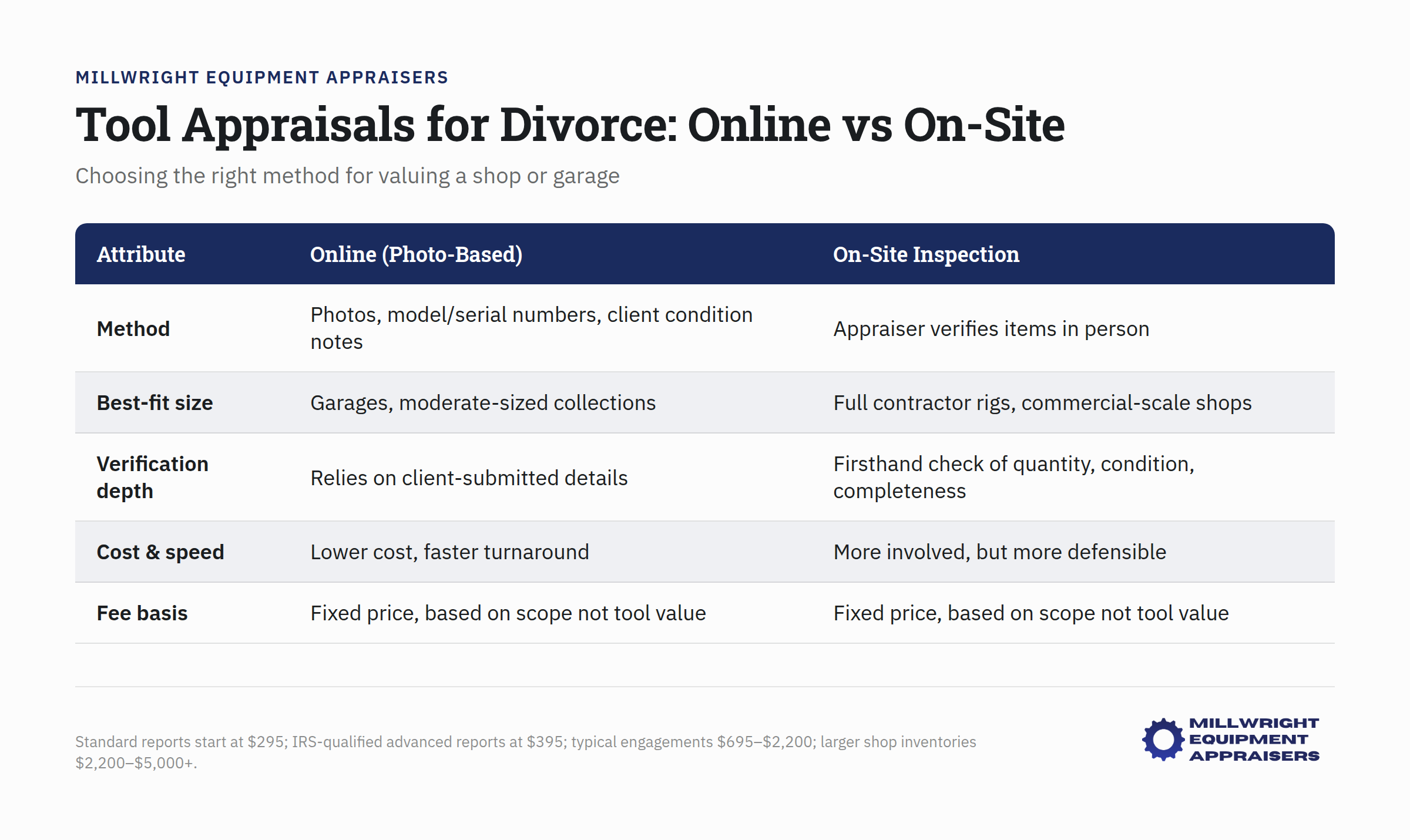
Fees for tool appraisals are quoted as a fixed price before work begins, never billed hourly. Our published pricing for tool appraisals starts at $295 for a standard report and $395 for an IRS-qualified advanced report, with typical engagements running $695 to $2,200 depending on the number of items and depth of research required; larger or more complex shop inventories can run $2,200 to $5,000 or more. What drives the fee is scope, the number of tools, the completeness of your records, and the level of detail the report needs to satisfy the court, never the dollar value of the tools themselves.
Getting the Number Right the First Time
A divorce already asks a lot of both spouses. The last thing either of you needs is a valuation fight over a truck bed of tools that could have been settled with one clear, independent report. A fair market value figure, tied to the correct valuation date and backed by a USPAP-compliant appraisal, gives your attorney something solid to work with in mediation or in court.
If you're facing a divorce and need a tool or equipment collection valued, request an appraisal and we'll scope the engagement based on your inventory, your timeline, and what your attorney needs the report to show.
This article is provided for general informational purposes only and does not constitute legal, tax, or financial advice. Readers should consult a qualified attorney regarding their specific circumstances.