
Blog
Do You Need a Separate Insurance Rider for a Valuable Tool Collection?
A standard homeowners policy often caps tool and equipment losses at a few hundred dollars and has no built-in way to prove the tools ever existed. This guide explains when a scheduled personal property endorsement makes sense for a tool collection and what documentation insurers require to add one.
A contractor with a loaded trailer or a hobbyist with decades of hand tools and machinery often assumes the homeowners policy already has it covered. It usually doesn't, not fully. Standard homeowners and renters policies are built around sublimits, named perils, and depreciation, three features that work against anyone trying to recover the real value of a tool collection after a fire, theft, or burglary. This guide walks through when a scheduled personal property endorsement is worth adding, what an insurer will ask for before approving one, and where our tool appraisal for insurance coverage fits into that paperwork.
What Your Homeowners Policy Actually Covers
Most homeowners and renters policies cover personal property only up to a stated limit, and that limit shrinks further for specific categories. Regulators describe special limits that commonly run around $500 for furs or jewelry and roughly $1,000 for firearms or computers, well below what a serious tool collection is worth, according to the National Association of Insurance Commissioners. Tools themselves are rarely named as their own category in a standard policy, which means they often get swept into a general contents sublimit shared with everything else in the house.
Three gaps show up over and over:
- Category sublimits. Even when the overall personal property limit looks generous, a sub-cap buried in the policy language can cut a tool claim down to a fraction of replacement cost.
- Named-peril restrictions. A standard policy typically covers fire and theft but may exclude mechanical breakdown, rust, mysterious disappearance, or loss from a jobsite, all common ways tools actually go missing.
- No built-in proof-of-existence requirement. Nothing in a standard policy forces the owner to document what they own before a loss happens, so the burden of proving the tools existed and what they were worth falls entirely on the claimant after the fact.
That last gap is the one that trips people up most often. Industry practice on insurance appraisals holds that the insured carries the burden of proving both the value of lost property and that it existed in the first place, which is exactly why documentation matters before a claim, not after.
When a Standard Policy Leaves a Contractor or Collector Exposed
A homeowners policy was built to protect a household's furniture, electronics, and clothing, not a shop full of specialty machinery or a career's worth of hand tools. Business use adds another wrinkle: tools kept for paid work, or stored at a jobsite rather than the home, frequently fall outside ordinary personal property coverage altogether. A commercial inland marine policy or a business property endorsement may be the more appropriate fit for tools used in a trade, and the policy language, not a general industry rule, controls which one applies.
There is no single nationwide dollar threshold that automatically triggers the need to schedule a tool collection. The commonly cited figures, like $500 or $1,000 sublimits, are policy-specific numbers described by regulators, not a universal legal floor. The only way to know for certain is to check the declarations page, the special limits of liability section, and any endorsement that defines tools, equipment, or business property.
What Is a Scheduled Personal Property Endorsement?
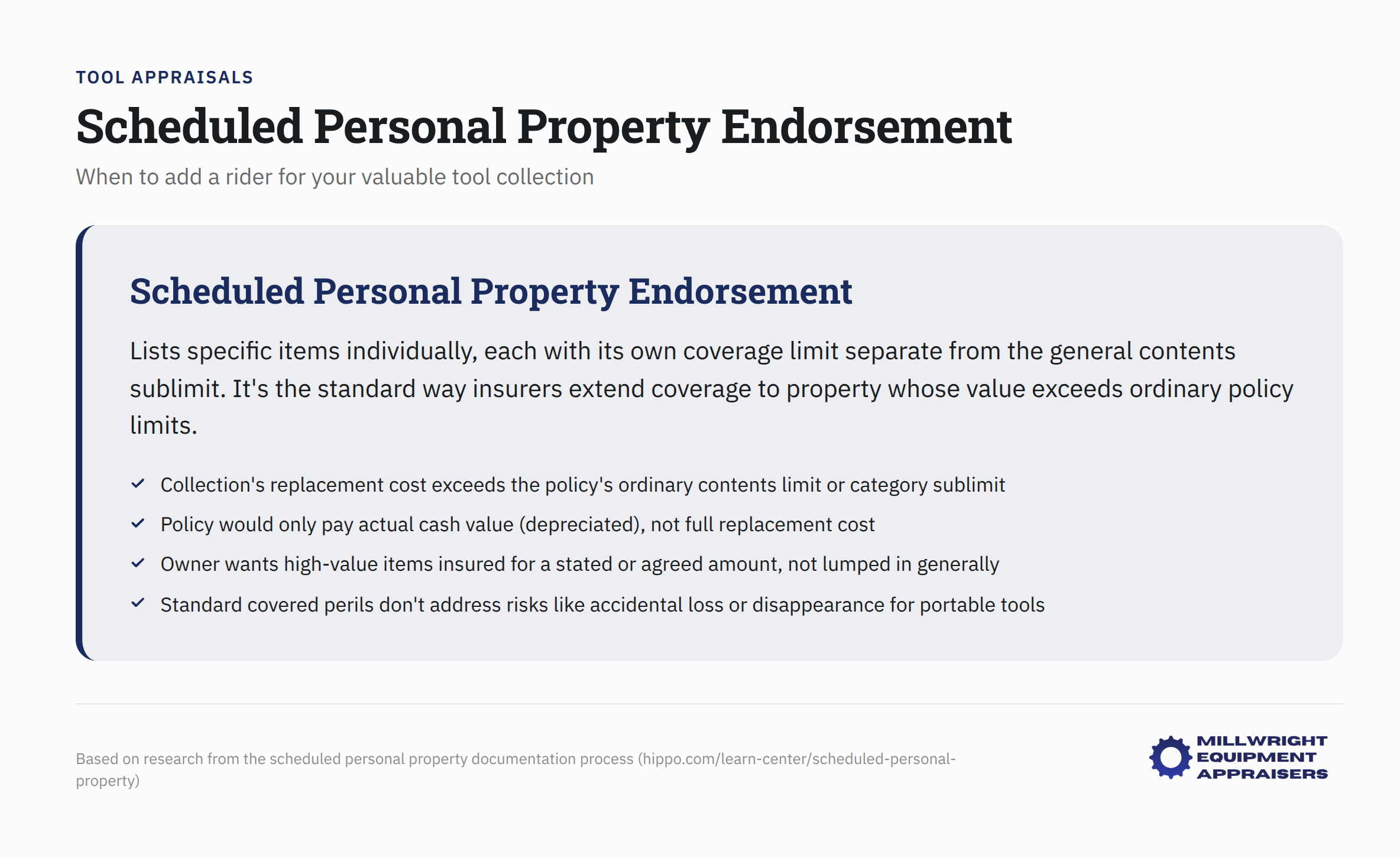
A scheduled personal property endorsement, sometimes called a personal articles floater, lists specific items individually and assigns each one its own coverage limit, separate from the general contents sublimit. It is the standard way insurers extend coverage to property whose value exceeds ordinary policy limits, according to research from the scheduled personal property documentation process.
Scheduling is generally worth pursuing when any of the following is true:
- The collection's replacement cost is higher than the policy's ordinary contents limit or category sublimit.
- The policy would pay actual cash value (replacement cost minus depreciation) rather than full replacement cost.
- The owner wants specific, high-value items insured for a stated or agreed amount rather than lumped in with everything else.
- The standard policy's covered perils don't address risks like accidental loss or disappearance that matter for portable tools.
Documentation Insurers Require to Schedule a Tool Collection
Insurers will not simply take an owner's word for what a tool collection is worth. Scheduling expensive personal property typically requires substantiated proof of value, and insurance regulators note that this often means a professional appraisal once the property in question is genuinely valuable, as described in guidance from the Indiana Department of Insurance.
In practice, most insurers ask for a combination of the following before adding or increasing a scheduled personal property endorsement:
- An itemized inventory. Every tool or piece of equipment listed separately, grouped by category (power tools, hand tools, machinery, specialty equipment).
- Photographs of each item or group. Clear images that would let an adjuster identify the property after a loss, not just a general shop photo.
- Serial and model numbers. Especially for stationary machinery, power tools, and anything with a manufacturer's identification plate.
- Proof of ownership and purchase. Receipts, purchase records, or credit card statements where available.
- A professional appraisal. Once an item or the collection as a whole climbs into the low thousands of dollars, insurers commonly want a written valuation prepared by a qualified appraiser rather than relying on the owner's own estimate.
That appraisal threshold is not fixed by statute, but it commonly lands somewhere between $2,500 and $5,000 per item or in aggregate for a collection, the point at which insurers stop accepting a homeowner's self-reported figure and start asking for independent documentation. Below that range, photographs and receipts are often sufficient. Above it, a written appraisal becomes the expected standard.
Pro tip: Keep the inventory and appraisal updated every few years. A collection built up gradually, a new welder here, a replaced table saw there, can cross the scheduling threshold without the owner ever noticing until a claim is already in progress.
Worked Example: A Contractor's Shop Collection
Consider a general contractor who has accumulated tools over 15 years: a table saw, a compressor, several cordless tool sets, a trailer-mounted generator, and a collection of older hand tools passed down from a parent.
| Category | Estimated Value |
|---|---|
| Power tools and cordless sets | $6,200 |
| Stationary shop equipment (table saw, compressor) | $9,800 |
| Trailer-mounted generator | $4,500 |
| Hand tools (including inherited vintage pieces) | $3,100 |
| Specialty and measuring equipment | $2,400 |
| Total | $26,000 |
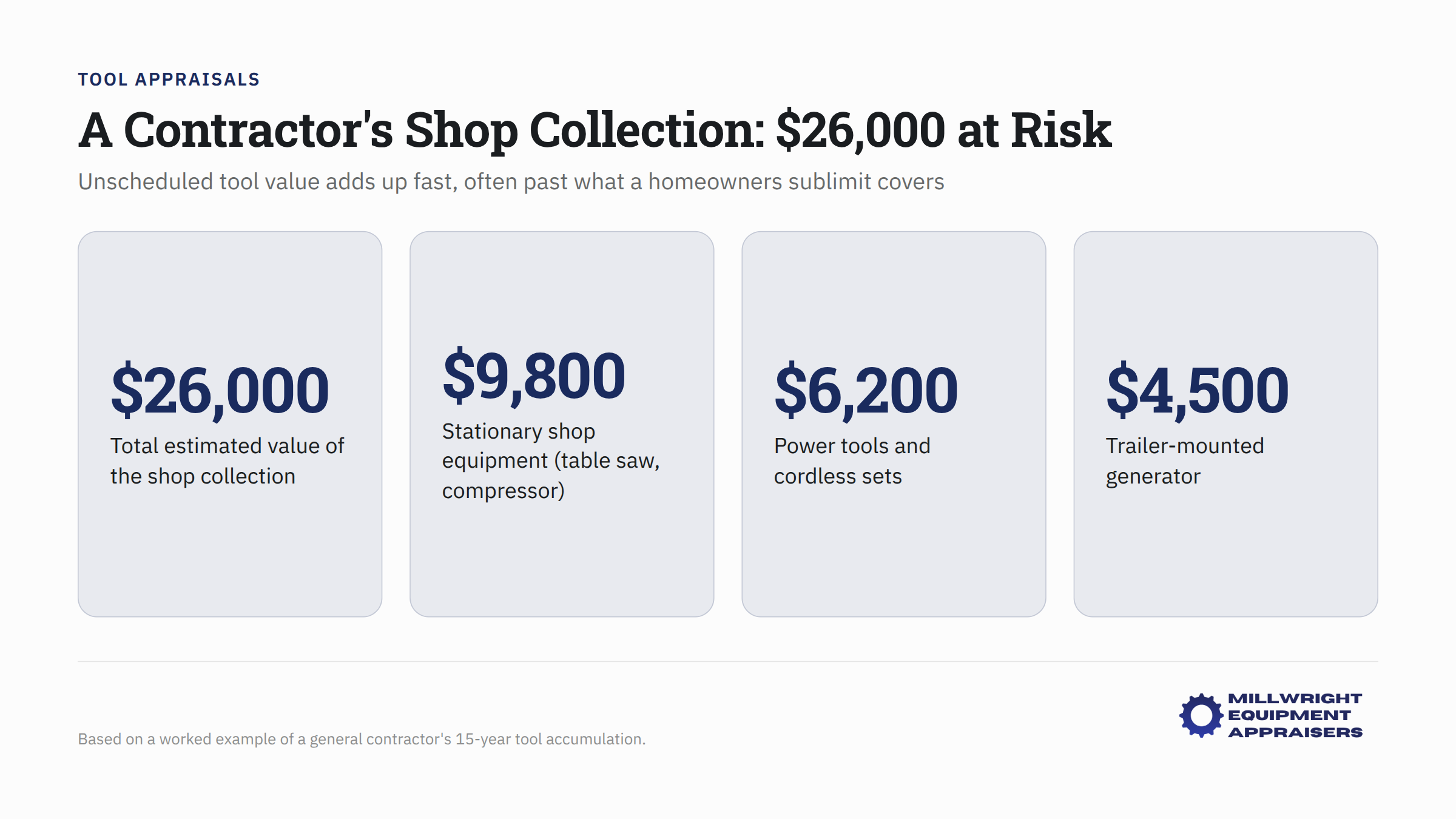
The contractor's homeowners policy caps unscheduled personal property, with tools and equipment subject to a modest category sublimit well under the $26,000 total. After a shop fire, the insurer would likely pay out only a fraction of the loss on the unscheduled portion, and would require the contractor to independently prove both the value and the prior existence of everything destroyed. By scheduling the collection ahead of time, backed by an itemized inventory, photographs, serial numbers, and a professional appraisal, the contractor converts that uncertain post-loss negotiation into a defined, pre-agreed coverage amount.
The Case for an Appraisal Before You Schedule
Insurance appraisals exist to accomplish a few specific things: they confirm the correct amount of coverage is in place, they create proof the property existed, they establish its condition before a loss, and they give the insurer a detailed, itemized replacement value to work from during a claim. All four matter for a tool collection, which tends to be mobile, easy to undervalue, and hard to reconstruct from memory after a fire or theft.
Most personal property insurance policies also include an appraisal clause: if the insured and the carrier can't agree on a claim's value after a loss, either side can invoke it, triggering a formal process where each party selects an appraiser and the two appraisers select an umpire to resolve the dispute. Having an appraisal already on file before a loss sidesteps that adversarial process entirely, since the valuation and documentation are already agreed upon.
Credentialed personal property appraisers, including those holding credentials with organizations such as the ISA, ASA, and AAA, prepare these reports with the level of detail insurers expect: itemized descriptions, condition notes, replacement value research, and supporting photographs. Our tool appraisal for insurance coverage service is built around exactly this kind of documentation, whether the goal is scheduling a collection for the first time or updating values before renewing a policy.
Protecting a Collection You've Spent Years Building
A tool collection built up over years of work or collecting deserves more protection than a general contents sublimit buried in a homeowners policy. If the replacement cost of a shop, a trailer, or a lifetime of hand tools runs into the thousands, the fastest way to find out whether a standard policy actually covers it is to read the special limits section and ask the insurer directly. If the answer is no, or if the owner simply wants certainty instead of a post-loss argument, a scheduled personal property endorsement backed by a professional appraisal closes that gap before it ever becomes a claim.
This article is provided for general informational purposes only and does not constitute legal, tax, or financial advice. Readers should consult a qualified insurance agent or attorney regarding their specific policy and circumstances.