
Blog
How to Meet IRS Requirements When Donating Tools
Donating hand tools, power tools, or a full shop collection to a nonprofit can trigger IRS appraisal rules once the claimed deduction passes $5,000. This guide walks through the Form 8283 thresholds, how fair market value is determined for used tools, and what a qualified appraisal must include.
Shop owners and serious hobbyists donate tools more often than people expect: a retiring machinist clearing out a garage, a contractor upgrading a fleet of power tools, a trade school receiving a donated set of equipment. The IRS treats these as noncash charitable contributions, and the paperwork requirements scale with the dollar amount you claim. Get the threshold wrong and you risk losing the deduction entirely, not just shrinking it.
This guide covers when a tool appraisal is legally required for a charitable donation, how fair market value is determined for used tools, and what a written report needs to include to survive IRS scrutiny.
What Triggers an Appraisal Requirement for Donated Tools?
A qualified appraisal is generally required once the claimed deduction for a tool, or a group of similar tools, exceeds $5,000. Below that threshold, you still need to report the donation, but a formal appraisal isn't mandatory.
The IRS treats donated tools as noncash property, and its noncash contribution rules apply the same way to a single power tool as they do to an entire shop's worth of equipment. The IRS guidance on substantiating noncash contributions sets the reporting thresholds, and once you cross $5,000 for an item or a group of similar items, the donee organization cannot serve as the appraiser and a qualified appraisal becomes mandatory.
The Dollar Thresholds That Decide Which IRS Form You Need
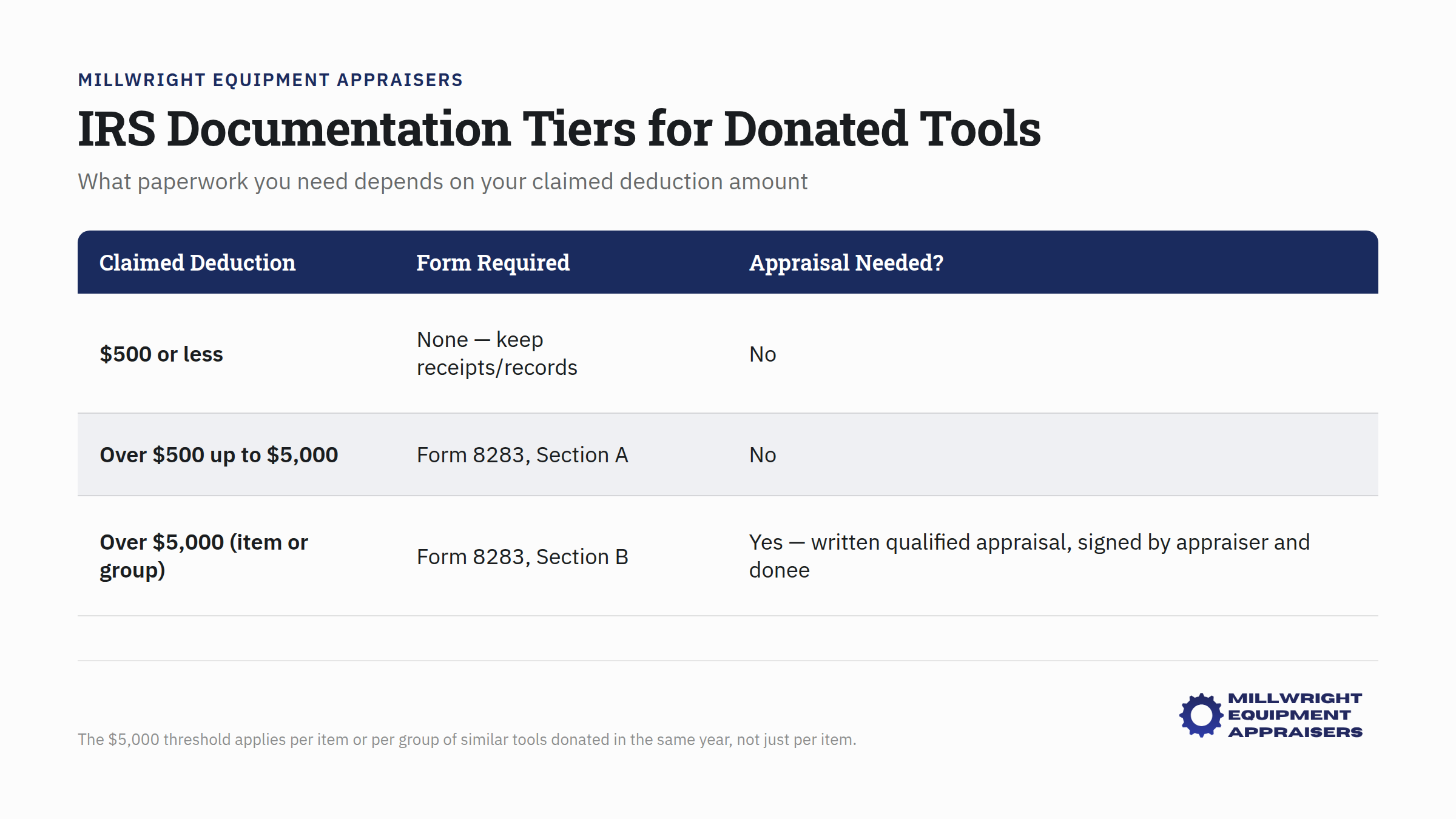
The amount you claim determines what paperwork the IRS expects, and the jump from one bracket to the next is not gradual. It's a hard line.
Claimed Deduction | Documentation Required |
|---|---|
$500 or less | Keep receipts and records; no separate form needed. |
Over $500 up to $5,000 | File Form 8283, Section A. No appraisal required. |
Over $5,000 (single item or group of similar tools) | File Form 8283, Section B. Requires a written qualified appraisal by a qualified appraiser, signed by both the appraiser and the donee organization. |
The $5,000 figure isn't per item. It applies to the item or, critically, to a group of similar items donated in the same year. A box of wrenches worth $300 doesn't need an appraisal on its own, but if you're also donating a table saw, a compressor, and a welder to the same organization and the combined value of that equipment tops $5,000, the whole group falls under Section B.
Why "Similar Items" Get Grouped Together
The IRS aggregates similar items specifically to prevent donors from splitting one large donation into several small ones to dodge the appraisal requirement. "Similar items" means property of the same general category, such as hand tools, power tools, or shop machinery, not necessarily identical brands or models.
As guidance summarized by the International Society of Appraisers explains, if you donate several items in the same general category and their combined fair market value exceeds $5,000, a qualified appraisal is required for the group even though no single item crosses the line on its own. The reverse also holds: dissimilar items that individually stay under $5,000 don't require an appraisal, even if your total charitable giving for the year is substantial.
Watch out: A common mistake is treating each donated tool as its own line item and assuming none needs an appraisal because no single tool is worth $5,000. If the group as a whole is similar property and crosses the threshold, the IRS expects Section B regardless of how you itemized the receipt.
How Fair Market Value Is Determined for Used Tools
Fair market value is the price a willing buyer would pay a willing seller in the used-tool market, not the original retail price and not what you paid for it new. Appraisers typically triangulate this figure using a combination of methods.
Cost or original selling price: What you paid, adjusted for how long ago the purchase occurred and how the used-equipment market has moved since.
Comparable sales: Recent sales of similar tools in similar condition, drawn from auction results, resale marketplaces, and dealer transactions for used equipment.
Replacement cost less depreciation: The cost of a comparable new tool today, reduced for age, wear, obsolescence, and remaining useful life.
None of these methods works in isolation for used shop equipment. A appraiser will usually weigh comparable sales most heavily when good data exists, and lean on replacement cost analysis for specialized or older equipment where resale comparables are thin. Per IRS Publication 561, fair market value reflects reasonable knowledge of relevant facts on both sides of the transaction, which is why condition, functionality, and completeness (does the tool include its original accessories, manuals, or cases) all factor into the final number.
Pro tip: Keep your original purchase receipts even for tools you've owned for years. They won't set the final value on their own, but they give the appraiser a useful anchor point and speed up the assignment.
Worked Example: A Shop Owner Donates Power Tools to a Trade School
Say a cabinet shop owner is downsizing and donates a set of used power tools to a local trade school's woodworking program. The load includes a table saw, a planer, a router table, a dust collection system, and several smaller items like clamps and hand tools.
Individually, the clamps and hand tools are worth $180 and $340. On their own, neither would need a form at all. But because they're similar property (shop tools) to the larger equipment in the same donation, everything gets aggregated for threshold purposes.
Item | Estimated FMV |
|---|---|
Table saw | $1,800 |
Planer | $1,200 |
Router table | $650 |
Dust collection system | $900 |
Clamps | $180 |
Hand tools | $340 |
Total | $5,070 |
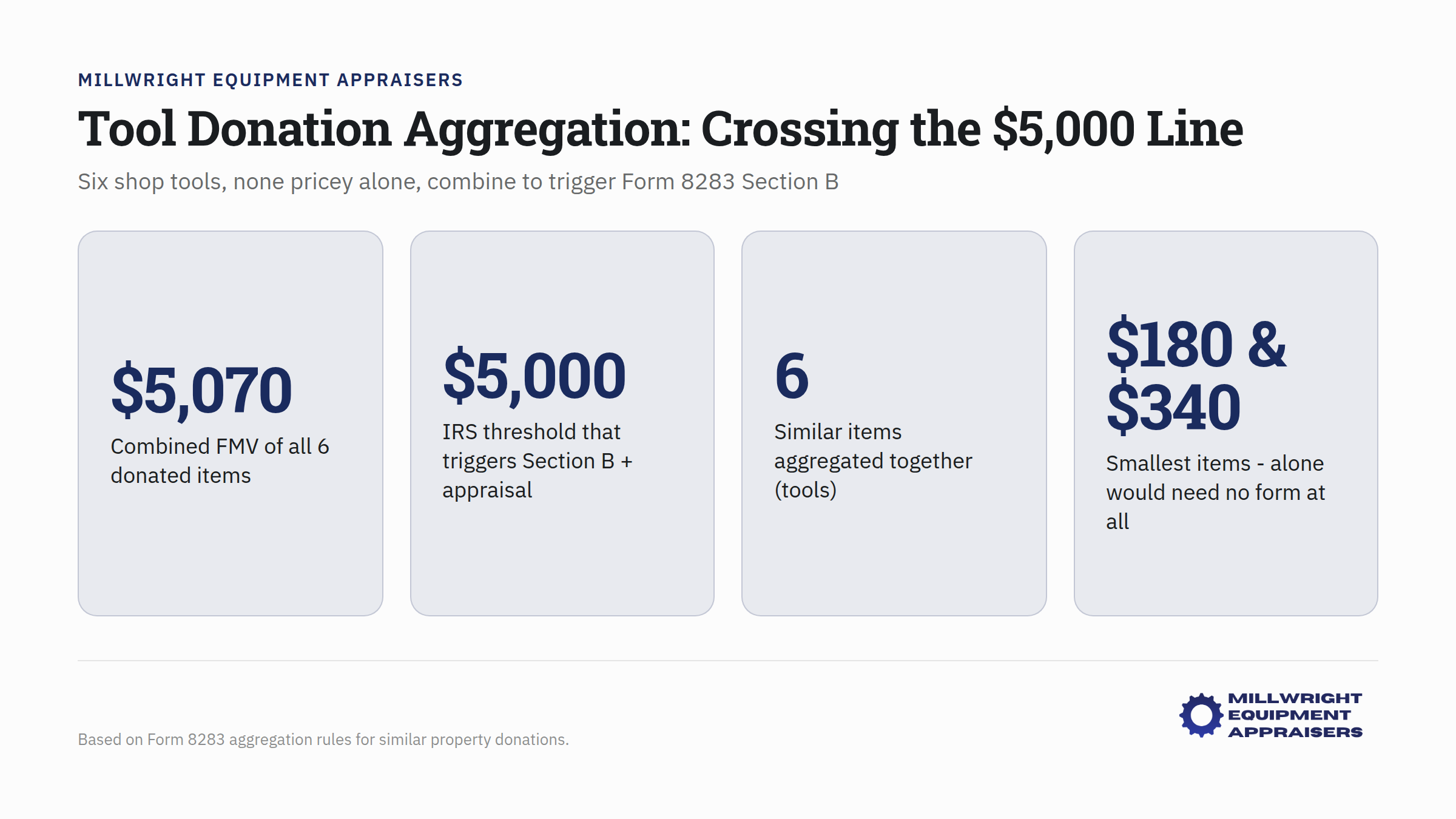
Because the combined fair market value of these similar items exceeds $5,000, the entire donation falls under Section B of Form 8283. The shop owner needs a written qualified appraisal covering the full group, signed by the appraiser and countersigned by the trade school as the receiving organization. Filing Section A for the smaller items and skipping the appraisal for the rest would understate what the IRS actually requires.
Who Qualifies as a Qualified Appraiser for Tools?
A qualified appraiser needs verifiable education and experience valuing the specific type of property involved, along with demonstrated knowledge of accepted valuation methodology; the donee organization itself can never serve as the appraiser. For tools and shop equipment, that typically means someone with credentials relevant to machinery and equipment valuation, such as the ASA, CAGA, NEBB, or ISA, working in accordance with USPAP (the Uniform Standards of Professional Appraisal Practice).
Our tool appraisal service prepares reports for both standard and IRS-qualified purposes. A standard tool appraisal is quoted starting at $295, while an IRS-qualified appraisal suitable for Section B of Form 8283 starts at $395, with the final fee scoped to the number of tools, the completeness of your records, and the depth of analysis the donation requires. Engagements are quoted as a fixed fee before any work begins; nothing is billed hourly.
Deadlines You Can't Afford to Miss
The appraisal itself must be completed no earlier than 60 days before the date of the donation, and it must be received before the due date, including extensions, of the tax return on which you first claim the deduction. File late or get the appraisal dated too far in advance of the gift, and the IRS can disallow the entire deduction on a technicality that has nothing to do with the actual value of what you donated.
Key takeaway: Order the appraisal close to the donation date, not months in advance, and make sure Form 8283 Section B is signed by both the appraiser and the receiving organization before you file.
Getting Your Tools Appraised the Right Way
Donating a set of tools to a trade school, a maker space, or a nonprofit workshop is a genuinely good use of equipment that would otherwise sit unused. The tax deduction is a real benefit, but only if the paperwork holds up. Once your claimed value for a tool or a group of similar tools crosses $5,000, a qualified appraisal isn't optional, it's the difference between a deduction that survives review and one that doesn't.
If you're planning a donation and want to confirm which threshold applies before you file, request an appraisal and we'll scope the assignment based on what you're donating and where it's headed.
This article is provided for general informational purposes only and does not constitute legal, tax, or financial advice. Readers should consult a qualified attorney or CPA regarding their specific circumstances.