
Blog
Grouping Similar Tools Under the IRS $5,000 Donation Appraisal Threshold
The IRS treats a shop full of similar tools as one aggregated group when testing the $5,000 qualified appraisal threshold, even if no single wrench or drill is worth much. This guide walks through the grouping rule and a worked example so you know when a tool donation needs a qualified appraisal.
Donating a garage or shop full of tools feels like giving away a pile of modest items: a socket set here, a circular saw there, nothing individually worth much. But the IRS doesn't test the $5,000 qualified appraisal threshold item by item. It tests it by group, and that single rule catches more tool donors off guard than almost anything else in the donation process.
This matters because getting it wrong has real consequences. Claim a deduction over $5,000 without the required qualified appraisal and Form 8283 Section B paperwork, and the IRS can disallow the entire deduction, not just the amount above the threshold. Below, we walk through how the grouping rule works, how it applies specifically to tools, and a worked numeric example so you can see exactly where the line sits.
What Is the IRS "Group of Similar Items" Rule?
The IRS requires donors to aggregate, not itemize, when testing dollar thresholds for noncash charitable contributions. Under guidance in IRS Publication 561, "similar items" of property means items of the same generic category or type, and the examples given include categories like books, stamp collections, and household appliances alongside things like furniture, jewelry, and electronic equipment.
Tools fit squarely into this framework. A collection of hand tools, a set of power tools, or a group of machinist tools donated in the same tax year gets tested as a single group, not as 40 or 50 separate low-value items. This is the mechanic that quietly pushes an ordinary shop cleanout past the appraisal threshold.
How the $500 and $5,000 Thresholds Work for Tool Donations
Two dollar thresholds control what paperwork a tool donation needs, and both apply to the group, not the individual tool.
- Over $500 but not more than $5,000 for the group: report the donation on Form 8283, Section A. No qualified appraisal is required at this level.
- More than $5,000 for the group: report on Form 8283, Section B, and obtain a qualified appraisal signed and dated by a qualified appraiser, per the IRS Instructions for Form 8283.
A donor who hands over 30 hand tools worth $150 to $300 apiece never crosses $500 on any single item, but the group total can land well past $5,000. That's the trap. The IRS Publication 526 guidance on figuring the deduction confirms that donors must consider all items in a similar-items group when testing these thresholds, even when the items don't go to the same organization.
Why a Modest Tool Donation Can Cross $5,000 Fast
The aggregation rule doesn't stop at a single charity. If a donor splits a tool collection between a trade school, a Habitat for Humanity ReStore, and a community workshop, the IRS still adds up every similar tool across all three donees when testing the $5,000 threshold. The classic IRS example involves a donor splitting a book collection among several colleges; each gift looks small on its own, but the aggregate still triggers the appraisal requirement. The International Society of Appraisers has noted that this multi-donee aggregation applies even though each donee only sees a fraction of the total group.
For a working woodworker or mechanic clearing out a shop, that means donating a table saw to one nonprofit and a set of hand planes to another doesn't dodge the threshold. If both fall into the same generic tool category and the combined value tops $5,000, a qualified appraisal is required, and a separate Form 8283 goes to each donee.
Worked Example: A Woodworker's Shop Donation
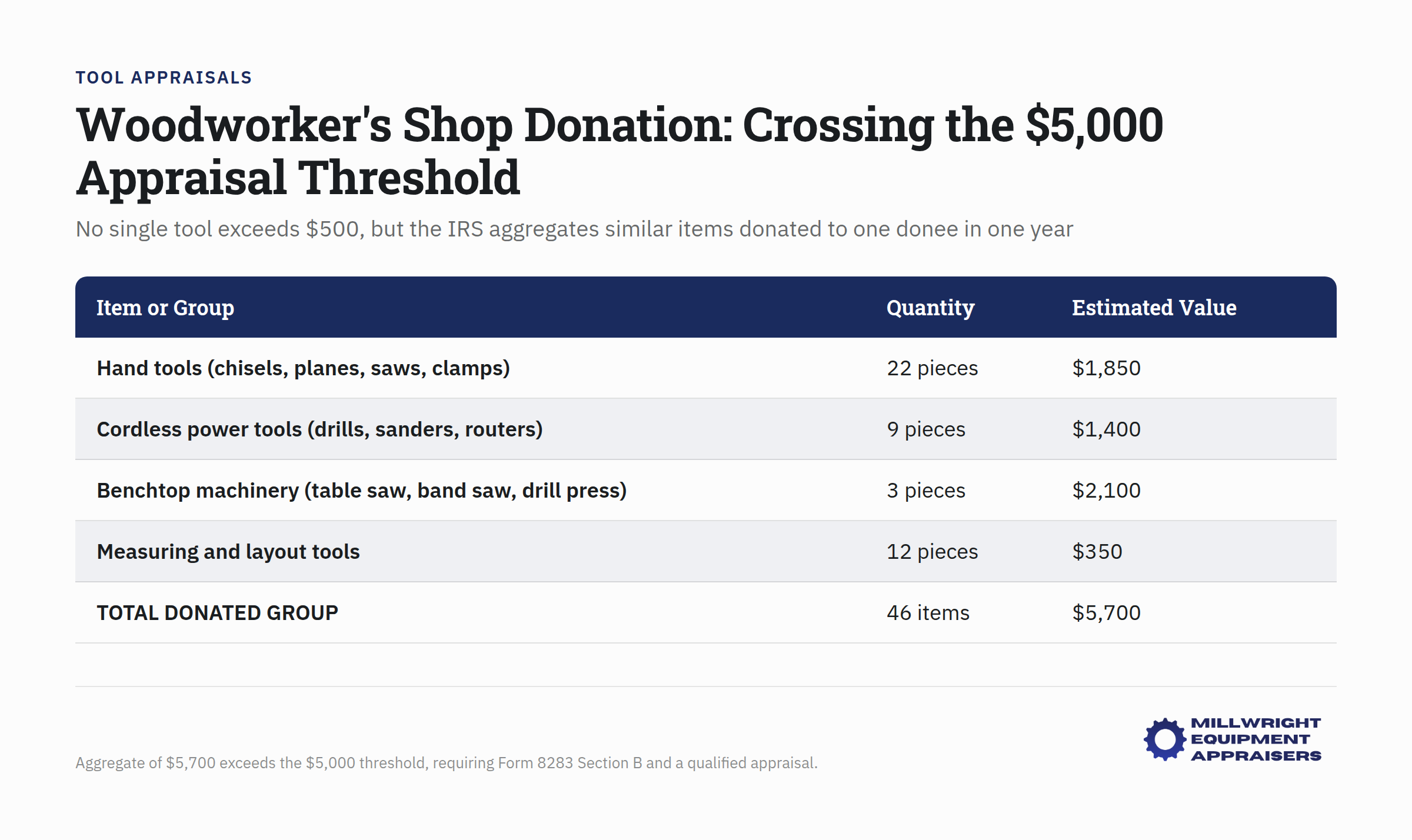
Consider a woodworker retiring and donating most of a home shop to a single trade school. No individual tool is expensive, but the group adds up.
| Item or group | Quantity | Estimated value |
|---|---|---|
| Hand tools (chisels, planes, hand saws, clamps) | 22 pieces | $1,850 |
| Cordless power tools (drills, sanders, routers) | 9 pieces | $1,400 |
| Benchtop machinery (table saw, band saw, drill press) | 3 pieces | $2,100 |
| Measuring and layout tools | 12 pieces | $350 |
| Total donated group | 46 items | $5,700 |
No single item in this list exceeds $500, so at first glance it might seem like Form 8283 Section A and no appraisal would apply. But because these are similar items (shop tools of the same generic type) donated in the same tax year to the same donee, the IRS tests the $5,700 aggregate, not each line item. That total is over $5,000, which means this donor needs Form 8283 Section B and a qualified appraisal before claiming the deduction.
Watch out: Used clothing and household items generally can't be deducted at all unless they're in good used condition or better, and any single household item claimed over $500 needs a qualified appraisal regardless of its category. Tools follow similar logic for condition: a rusted-out drill press claimed at a high value invites IRS scrutiny even below the $5,000 group threshold, so keep condition documentation (photos, maintenance records) alongside your itemized list.
Which Tools Count as "Similar"? Categories That Do and Don't Aggregate
Not every tool in a shop belongs to the same group. The IRS draws the aggregation line at "same generic category or type," the same standard that keeps china separate from everyday kitchenware in its published examples. Genuinely different tool categories can be analyzed as distinct groups.
- Hand tools: wrenches, screwdrivers, chisels, planes, and clamps typically aggregate together as one category.
- Power tools: cordless drills, sanders, routers, and saws form their own generic category, separate from hand tools.
- Stationary shop machinery: table saws, band saws, and drill presses can reasonably be treated as a distinct machinery category rather than lumped with hand-held power tools.
- Automotive diagnostic equipment: scan tools and specialty automotive gear are a different generic type from woodworking tools entirely, even if both came out of the same garage.
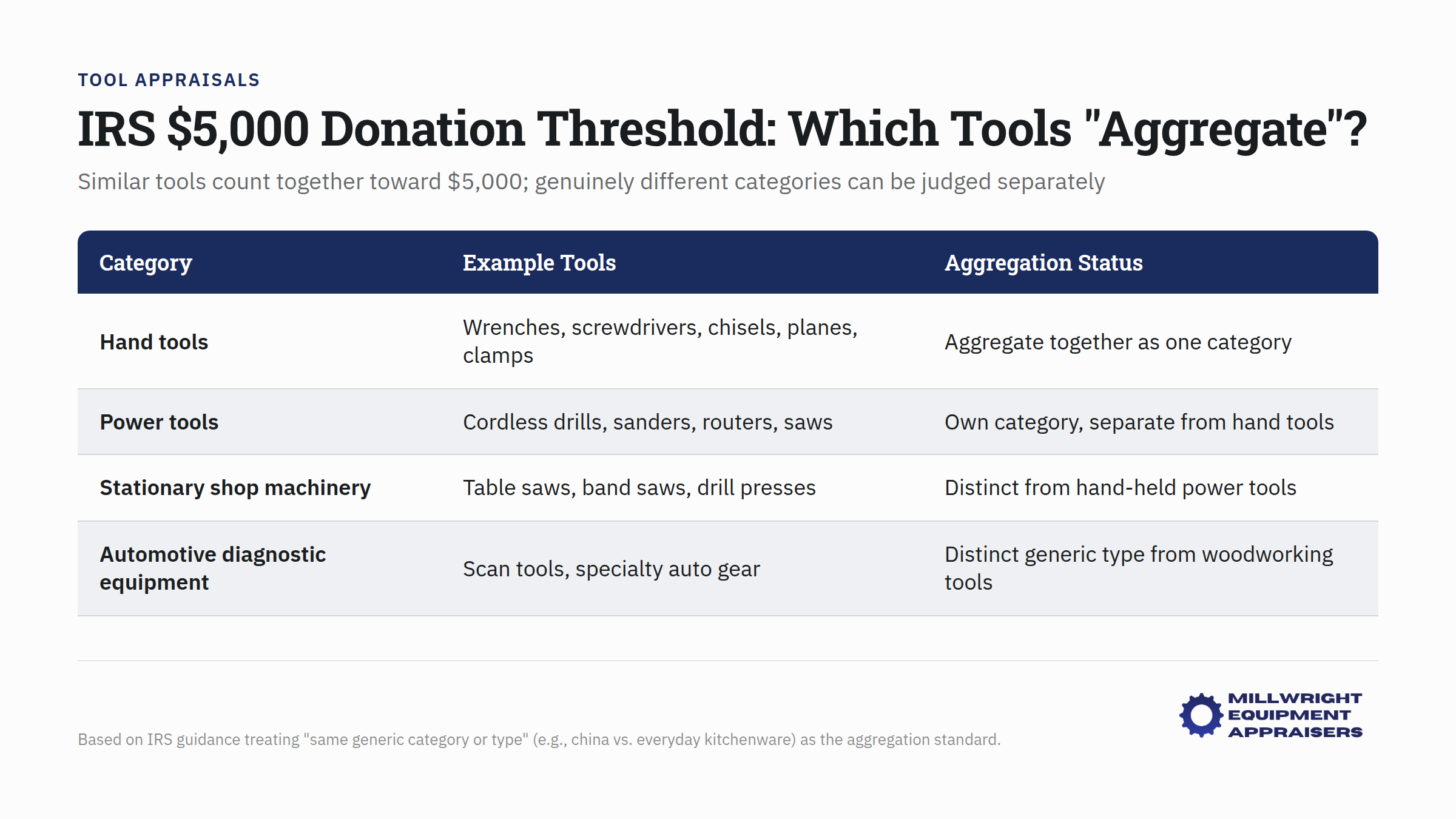
This distinction matters because a donor with $3,000 of hand tools and $2,800 of automotive diagnostic equipment might genuinely have two separate groups, each under $5,000, rather than one aggregated group of $5,800. Getting the categorization right is exactly the kind of judgment call a qualified tool appraisal is built to make, since misclassifying dissimilar tools as one group (or vice versa) can either overstate the appraisal requirement or understate it.
One Appraisal, Multiple Donees: How Grouping Affects Form 8283
Here's the part that actually works in the donor's favor: only one qualified appraisal is needed to cover an entire group of similar tools contributed within the same tax year, even when those tools go to more than one charity. The appraisal report can address the full group in a single document as long as it includes all the required information for each item.
What doesn't consolidate is the tax form itself. A separate Form 8283 is required for each donee organization. So a donor splitting a $6,000 tool group between a trade school and a resale nonprofit still files two Forms 8283, one per recipient, but only needs to commission one appraisal to support both.
Pro tip: If you know upfront that a tool donation will be split across multiple charities, tell your appraiser before the engagement starts. A single report scoped to cover the full group up front is more efficient than commissioning separate appraisals after the fact.
Getting the Threshold Right Before You File
The grouping rule is easy to miss because it runs against intuition: a shop full of $50 wrenches and $150 screwdrivers doesn't feel like a $5,000 donation, but the IRS adds it up as one. Before donating a substantial tool collection, tally the group by category, compare the total to $5,000, and get a qualified appraisal whenever the aggregate crosses that line.
Our tool appraisal team prepares USPAP-compliant, IRS-qualified reports for exactly this situation, whether a donation is going to one charity or split across several. Advanced (IRS-qualified) tool appraisals are quoted as a fixed fee after we scope the assignment, based on the number of items and categories involved, not billed hourly. For donors weighing whether their shop crosses the threshold at all, our guide on meeting IRS requirements for tool donations covers the documentation you'll need alongside the appraisal itself.
This article is provided for general informational purposes only and does not constitute legal, tax, or financial advice. Readers should consult a qualified attorney or CPA regarding their specific circumstances.