
Blog
Fair Market Value vs. Replacement Cost: Which Number Applies to Your Tools?
Fair market value and replacement cost are not interchangeable numbers for tools: one governs IRS and estate work, the other governs insurance claims, and using the wrong one can cost you a deduction or an insurance payout.
Two Different Answers to "What Are My Tools Worth?"
Ask what a used tool collection is worth and you can get two very different, both correct, answers depending on why you're asking. An estate filing, a charitable donation, or a divorce settlement calls for fair market value. An insurance claim after a fire, theft, or flood calls for replacement cost. Confusing the two is one of the most common mistakes we see, and it can mean a rejected IRS deduction on one end or a shortchanged insurance settlement on the other.
Our tool appraisal for estate and probate work and our tool appraisal for insurance coverage work both start with the same shop full of tools, but they end in two different reports built on two different value standards. Here's how to tell which one you need.
What Is Fair Market Value for Tools?
Fair market value is the price a tool would sell for on the open market between a willing buyer and a willing seller, with neither side under pressure to act and both having reasonable knowledge of the relevant facts. IRS Publication 946 uses this exact framing, and it's the standard that governs estate valuations, charitable donation appraisals, gift tax filings, and most divorce property divisions.
Fair market value looks backward at what similar used tools have actually sold for, not forward at what a new one costs. A ten-year-old table saw isn't valued at what a comparable saw costs at the hardware store today. It's valued at what that specific saw, in its actual condition, would fetch from a real buyer in the used tool market: at an auction, through a dealer, or in a private sale.
Condition and age matter enormously here. A wrench set with surface rust, worn markings, and a few missing sockets is worth less in fair market value terms than an identical set in excellent condition, even though both cost the same when new.
What Is Replacement Cost for Tools?
Replacement cost is the amount it would take to replace a lost or damaged tool with one of similar kind and quality within a reasonable amount of time in the relevant marketplace. This is the number insurance policies are built around, and it answers a completely different question: not "what would this sell for used," but "what does it cost to make you whole again."
Most commercial tool and equipment policies split this further into two coverage types. Replacement cost value (RCV) pays what it costs to buy a new item of like kind and quality, with no deduction for depreciation. Actual cash value (ACV) pays replacement cost minus depreciation, which functions as a rough stand-in for fair market value at the time of loss, according to industry guidance on equipment insurance. Many insurers apply an age-based rule of thumb: tools under about five years old are commonly covered on a replacement cost basis, while older tools shift to actual cash value, per contractor equipment insurance guidance.
Why the IRS Says These Numbers Rarely Match
Fair market value and replacement cost measure two different things, and the IRS is explicit that one cannot substitute for the other. Book value, replacement cost new, and insurance replacement value are not acceptable stand-ins when fair market value is the required standard for a tax filing or appraisal. A brand-new equivalent tool almost always costs more than a used one sells for, so replacement cost tends to run well above fair market value for anything with meaningful age or wear.
Watch out: Submitting a replacement cost figure on an IRS Form 8283 charitable donation appraisal, or in an estate inventory, is a common error that can get a deduction challenged or a filing kicked back for correction.
Fair Market Value vs Replacement Cost at a Glance
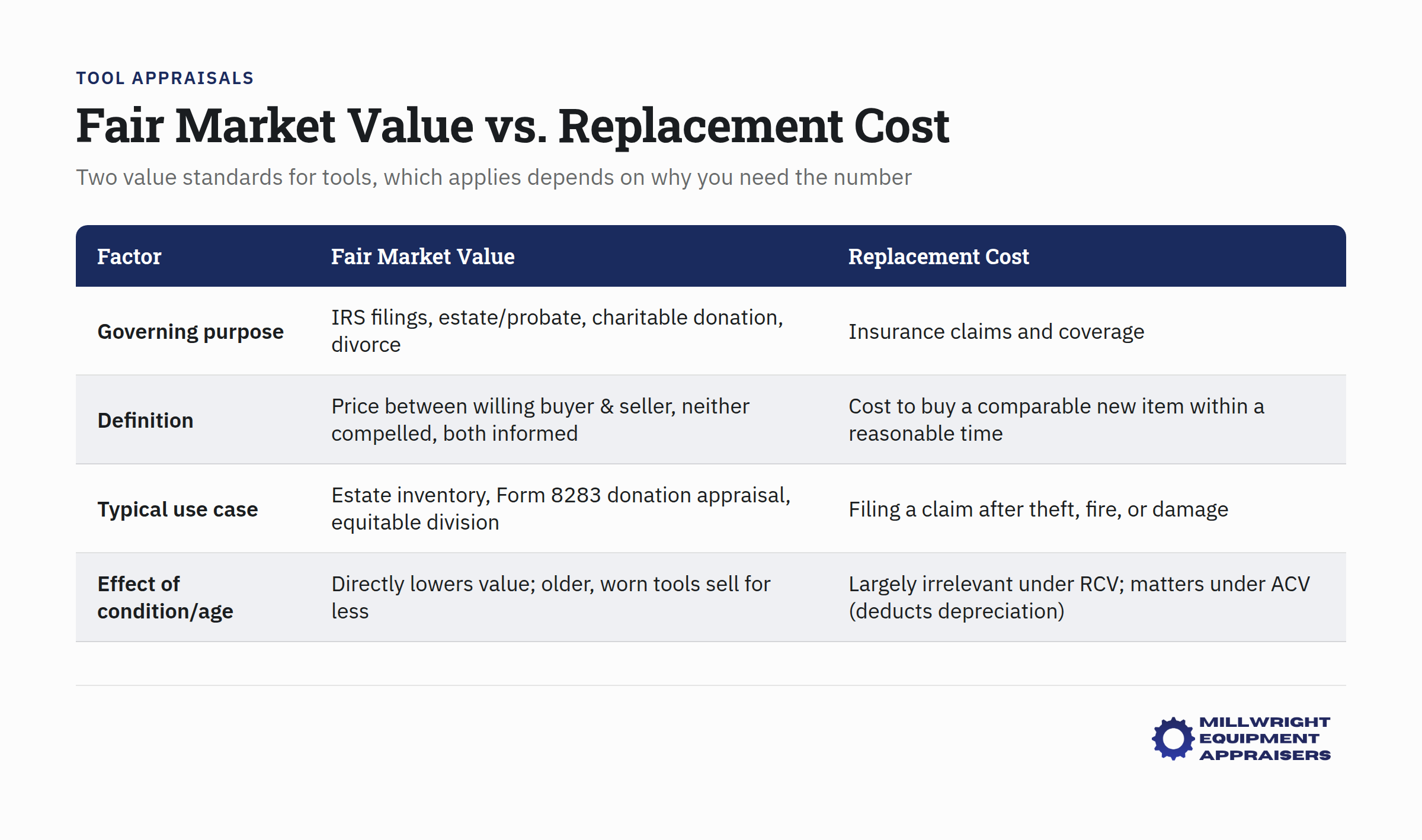
The table below lays out how these two value standards differ across the questions that matter most when scoping an appraisal.
| Factor | Fair Market Value | Replacement Cost |
|---|---|---|
| Governing purpose | IRS filings, estate and probate, charitable donation, divorce | Insurance claims and coverage |
| Definition | Price between a willing buyer and willing seller, neither compelled, both informed | Cost to buy a comparable new item within a reasonable time in the relevant market |
| Typical use case | Estate inventory, Form 8283 donation appraisal, equitable division | Filing a claim after theft, fire, or damage |
| Effect of condition and age | Directly lowers value; older, worn tools sell for less used | Largely irrelevant under RCV coverage; matters under ACV, which deducts depreciation |
Worked Example: A Used Mechanic's Wrench Set
Consider a mid-range mechanic's wrench set purchased new for around $400 several years ago. It has moderate wear: some surface rust on a few sockets, faded markings, and one replacement wrench from a different brand after an original piece was lost.
Example: For an estate inventory, an appraiser would research what comparable used wrench sets in similar condition actually sell for at auction, through pawn and resale channels, or via dealer trade-in offers. That research might support a fair market value of $110 to $150. For an insurance claim on the same set, the insurer's replacement cost figure would be based on what a new set of similar quality costs today, likely $380 to $420, before any depreciation adjustment under an ACV policy.
The gap between those two numbers isn't an error. It's the expected difference between a used-market price and a new-purchase price.
Worked Example: A Cordless Drill/Driver Combo Kit
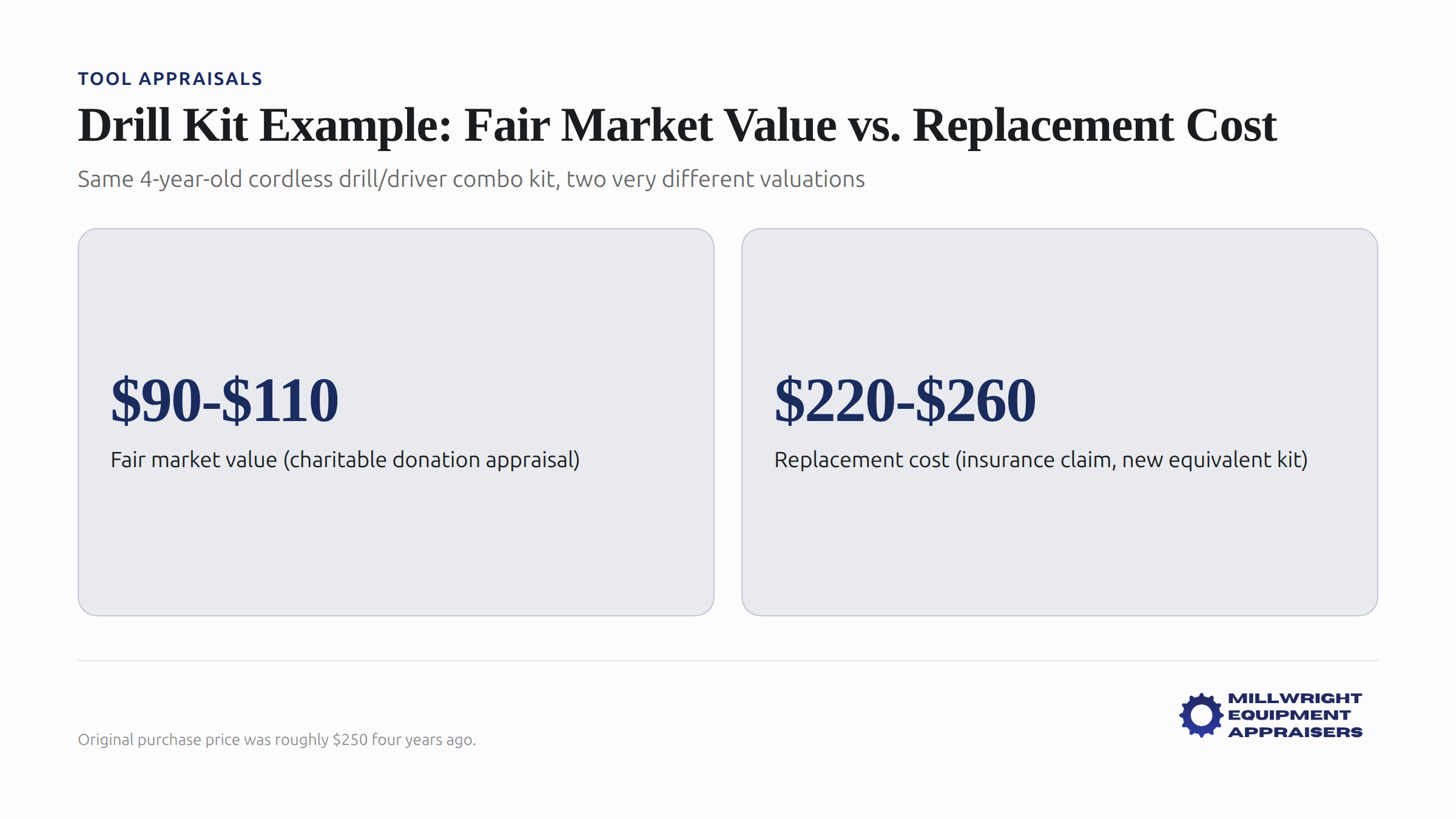
Now take a cordless drill/driver combo kit bought four years ago for roughly $250. The batteries still hold a charge, the case is intact, but the tools show scuffing and one charger contact is slightly corroded.
Example: A fair market value appraisal for a charitable donation would look at completed sales of comparable used kits in similar condition, landing somewhere around $90 to $110. A replacement cost figure for an insurance claim would reflect what it costs to buy an equivalent new kit today, likely $220 to $260, since battery tool platforms rarely lose much retail price over a few years even as the used unit itself depreciates.
Which Number Should You Request?
The short answer is that the purpose of your appraisal decides the standard of value, not the tools themselves. The same drill kit can carry two legitimate numbers depending on why it's being valued.
- Estate and probate filings: request fair market value, since executors and courts need a value that reflects what the tools would actually bring if sold.
- Charitable donation appraisals: request fair market value, since the IRS requires it for any donation over the $5,000 qualified appraisal threshold.
- Divorce and equitable distribution: request fair market value, so both parties are dividing property at its real resale worth.
- Insurance coverage reviews and claims: request replacement cost (or confirm whether your policy pays RCV or ACV), since that's the figure your insurer will use to settle a loss.
Our fixed-fee tool appraisals for standard reporting start at $295, with IRS-qualified reports for estate, donation, and probate use starting at $395. Every engagement is quoted as a flat fee once we understand the scope, the number of tools, and the intended use of the report, never billed by the hour.
Getting the Right Number the First Time
Requesting the wrong value standard doesn't just create a paperwork headache. It can mean a denied charitable deduction, a probate inventory that undervalues an estate, or an insurance settlement that leaves you short after a loss. Telling your appraiser exactly why you need the report, whether it's headed to the IRS, a court, or an insurance adjuster, is the single most useful thing you can do before the engagement even starts.
If you're not sure which standard applies to your situation, our team can walk through the intended use with you before scoping the assignment through our request an appraisal page.
This article is provided for general informational purposes only and does not constitute legal, tax, or financial advice. Readers should consult a qualified attorney or CPA regarding their specific circumstances.