
Blog
Executor's Guide to Tool Appraisals for Estates
A tool appraisal for estate settlement establishes the fair market value of a decedent's tools and shop equipment as of the date of death, the number probate courts and the IRS actually require. This guide explains when you need one, how the value is used, and why online comps get rejected.
Settling an estate that includes a workshop, a contractor's tool trailer, or a garage full of power tools puts an executor in an unfamiliar spot fast. You're expected to put a defensible dollar figure on equipment you may not fully understand, on a deadline, while also managing grief, paperwork, and a court that wants a real number, not a guess.
A tool appraisal for estate settlement is the process of establishing fair market value for a decedent's tools, machinery, and shop equipment as of the date of death, in a form that satisfies probate courts and, when the estate is large enough, the IRS. Our tool appraisal for estate and probate service exists specifically to give executors that number without the guesswork. This guide walks through when you need one, how the value gets used, and what separates a report that holds up from one that gets sent back.
What Does a Tool Appraisal for Estate Settlement Actually Involve?
A tool appraisal for estate settlement identifies and values every relevant tool, piece of shop equipment, or machine in the estate at fair market value as of the decedent's date of death, not today's asking price. Fair market value is the price a willing buyer and a willing seller would agree to, with neither under pressure to act and both reasonably informed about the item's condition and market.
For a workshop or garage, that means an appraiser inspects each item as it sits, notes make, model, serial number, and condition, and researches comparable sales through auctions, dealer records, and equipment marketplaces around the date of death. The result is a written report with a stated methodology and a supportable conclusion of value, not just a list of numbers pulled off a resale website.
This differs from a casual walkthrough or a family member's best guess in one important way: it is prepared to be defensible. Probate courts and, when applicable, the IRS expect an independent, standards-based report, and that standard is the Uniform Standards of Professional Appraisal Practice (USPAP).
When Do You Need a Tool Appraisal, and When Don't You?
You need a tool appraisal when the estate is entering probate and the court requires a formal inventory, when the tools represent meaningful value relative to the rest of the estate, or when heirs disagree about how to divide or split the value of the equipment. You generally don't need one for a handful of common hand tools worth a few hundred dollars total with no dispute among heirs.
A formal appraisal becomes especially important in these situations:
- The estate is subject to probate and the court requires a documented inventory of personal property before administration can proceed.
- The gross estate approaches or exceeds the federal estate tax exemption, which triggers a Form 706 filing and IRS scrutiny of every valuation in the return.
- Multiple heirs are dividing the estate and one wants to keep the tools or workshop, requiring a fair buyout figure.
- The tools were part of a trade or business, such as a contractor's rig, a machine shop, or a working farm, where the equipment carries real commercial value.
- A prior informal estimate is being challenged by a beneficiary, a co-executor, or the court itself.
Informal estimates, whether from a family friend, a used-tool dealer, or an online marketplace search, are routinely rejected by probate courts, which is a big reason executors end up needing a redo under deadline pressure.
Why the Federal Estate Tax Threshold Matters for Tool Values
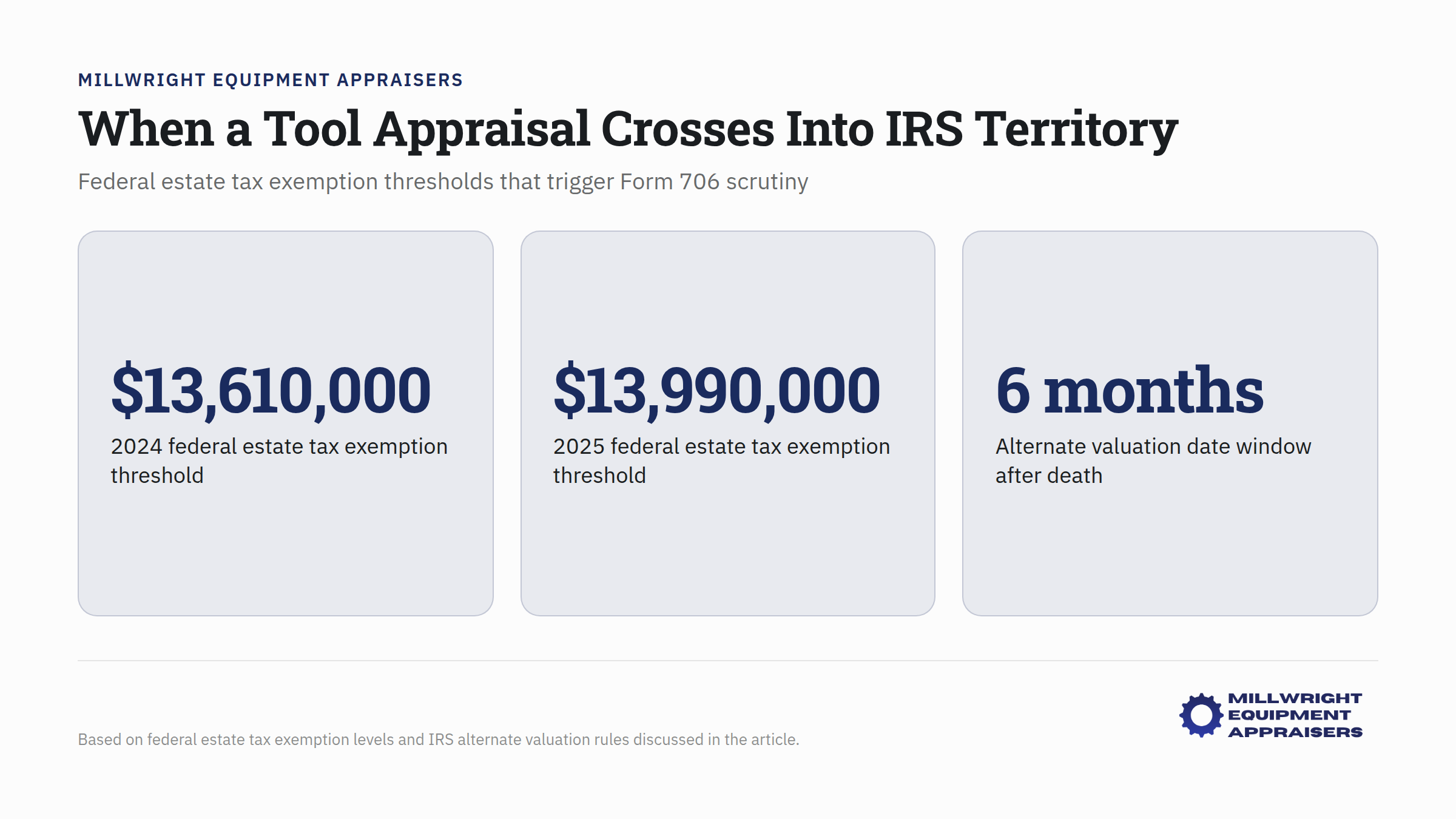
The federal estate tax threshold determines whether tool values in an estate face IRS scrutiny at all. If the gross estate plus adjusted taxable gifts stays under the exemption, no Form 706 is required and the tool valuation mainly serves the probate inventory and the heirs. Cross that line, and every asset, including the tools in the garage, needs a supportable fair market value.
For deaths in 2024, the federal estate tax exemption was $13,610,000. For deaths in 2025, it rose to $13,990,000. When a decedent's gross estate plus adjusted taxable gifts exceeds that year's threshold, the executor must file Form 706 and report every included asset, tools and equipment among them, at fair market value as of the date of death or the alternate valuation date if elected.
Most estates fall well under that number, but tool and equipment collections tend to get underestimated. A contractor's full trailer of commercial-grade power tools, a machinist's shop, or a serious woodworking collection can carry more value than an executor expects, and undervaluing it on a Form 706 creates real exposure if the IRS later questions the return.
Watch out: Executors sometimes assume tools are too minor to matter for estate tax purposes and skip a formal valuation entirely. If the estate is anywhere near the exemption threshold, that assumption can create problems the executor is personally accountable for.
Fair Market Value at Date of Death vs the Alternate Valuation Date
Fair market value for estate purposes is calculated as of the decedent's date of death by default, meaning the appraiser values the tools as they existed and as the market stood on that specific day, not when the appraisal is actually performed. This retrospective valuation is standard across estate appraisal work, whether the asset is real estate, securities, or shop equipment.
An executor can instead elect the alternate valuation date, which is six months after the date of death, if doing so lowers the estate's overall taxable value. This election applies to the entire estate, not to individual assets, so it's a decision made with the estate's full picture in view, usually alongside a CPA or estate attorney.
Example: A machinist dies owning a shop full of CNC and metalworking equipment. If equipment values in that market softened over the following six months, the executor might elect the alternate valuation date so the estate reports the lower figure, potentially reducing estate tax exposure. If values held steady or rose, sticking with the date of death is usually the better call.
Whichever date applies, the appraiser needs to know it before starting work, since the entire research process (comparable sales, market conditions, condition assessment) is anchored to that specific point in time.
Using the Appraisal to Divide Assets and Support Buyouts Among Heirs
An independent tool appraisal gives an executor a neutral number to divide equipment fairly among heirs or to support a buyout when one heir wants to keep the workshop. Without that figure, executors are left negotiating division based on guesses, which is where estate disputes usually start.
Example: Three siblings inherit their father's estate, which includes a paid-off house, some savings, and a fully equipped woodworking shop. One sibling wants the shop. A tool appraisal values the equipment at $38,000. That sibling can then buy out the other two at $12,667 each from their share of the estate, or the estate can adjust the division of other assets to balance it out. Without an appraisal, that conversation has no anchor and tends to get personal fast.
Courts overseeing probate also rely on this figure to confirm the inventory is accurate and that no heir is being shortchanged, which protects the executor from later claims of mismanagement.
Stepped-Up Basis and Future Capital Gains
The fair market value established in a tool appraisal becomes the heir's stepped-up basis for those tools going forward, which directly affects any capital gains tax owed if the tools are later sold. Without a documented appraisal, an heir who sells inherited equipment has no clear basis to work from and may end up overpaying capital gains tax or facing an IRS challenge if they estimate low.
Example: An heir inherits commercial welding equipment appraised at $22,000 as of the date of death. Two years later, they sell it for $25,000. Their taxable gain is $3,000, the difference between sale price and the stepped-up basis, not the $25,000 sale price itself. Without the appraisal establishing that $22,000 basis, the heir has no defensible number to report and risks the IRS treating the entire sale amount as gain.
This is one of the most overlooked reasons to get a proper appraisal even when an estate is nowhere near the federal exemption. The appraisal isn't just for the executor's paperwork today; it protects the heir's tax position years down the road.
Why Courts and the IRS Reject Informal Valuations
Probate courts and the IRS reject informal valuations because they lack independence, documented methodology, and a clear connection to the correct valuation date, all of which a court or examiner needs to trust the number. An heir's estimate, a dealer's quick quote, or a price copied from an online listing doesn't hold up under that scrutiny.
A defensible report needs to show its work: what each item is, what condition it's in, what comparable sales support the conclusion, and why that data was gathered around the correct date. According to general guidance for executors on determining estate asset value, independent, documented valuations are what courts expect before approving inventories or distributions, and informal estimates routinely get sent back.
The IRS holds a similar standard for property reported on an estate tax return. Guidance on qualified appraisals for estate and gift tax purposes calls for a clear description of each asset, the valuation methodology used, and a stated conclusion tied to the correct date, the same bar that applies whether the asset is a painting or a fully equipped machine shop.
Key takeaway: An online marketplace search tells you what someone is asking for a similar tool today. It does not tell a court or the IRS what a willing buyer and seller would have agreed to on the date of death, which is the only number that actually matters here.
What to Expect From the Appraisal Process and Report
A tool appraisal for estate settlement typically moves through a short, structured process rather than a single walkthrough, and it produces a written report an executor can hand directly to the court or attach to a Form 706.
- Initial Scoping Call
- We confirm the valuation date (date of death or alternate valuation date), the intended use of the report, and the rough scope of the tools and equipment involved.
- Inspection and Documentation
- The appraiser catalogs each item, noting brand, model, serial number, and condition, either in person or through detailed photographs and records provided by the executor.
- Market Research
- The appraiser researches comparable sales through auctions, dealer transactions, and equipment marketplaces relevant to the valuation date.
- Report Preparation and Delivery
- The finished report states the methodology, the comparable data, and the concluded fair market value for each item and the collection as a whole, prepared in accordance with USPAP.
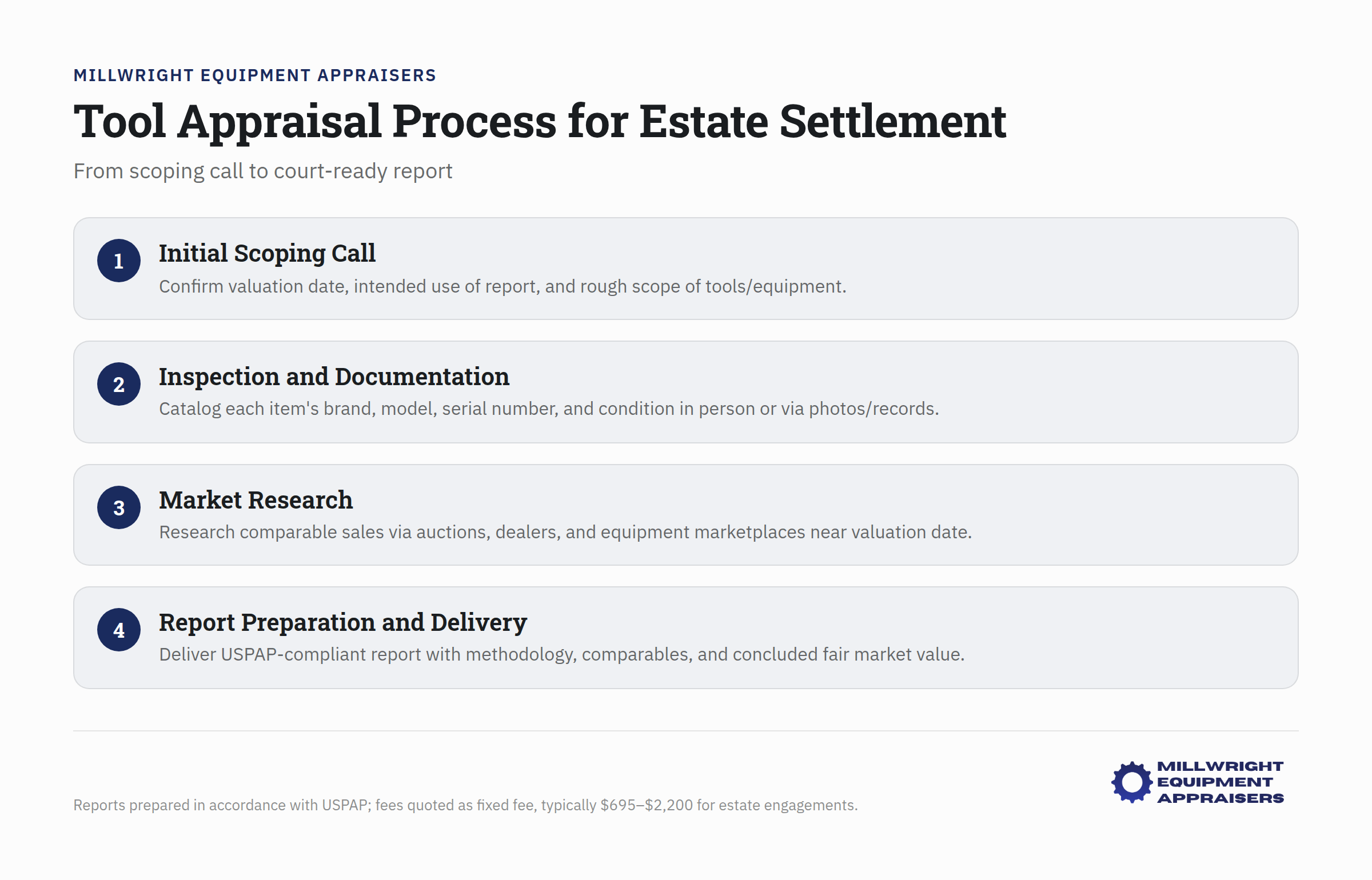
For tool appraisals, our pricing is quoted as a fixed fee after scoping the assignment, generally starting from $295 for standard reporting or $395 for IRS-qualified reporting, with typical estate engagements running $695 to $2,200 depending on the number and complexity of the items involved. Larger commercial shops or highly specialized equipment can run higher. Fees are never billed hourly and are always set before work begins, driven by the scope of the assignment (how many items, how much documentation exists, and whether the report needs to meet IRS-qualified standards), not by the value of the tools themselves.
Appraisers who work in this space commonly hold credentials with organizations such as the ASA, ISA, and CAGA, and every report should be prepared in accordance with USPAP regardless of which credential the individual appraiser carries.
Getting the Number Right Before the Deadline Hits
An executor's job is hard enough without guessing at what a decedent's tools and shop equipment are worth. A proper appraisal gives you a number the court will accept, a fair basis for dividing assets among heirs, and a documented stepped-up basis that protects whoever inherits the equipment down the road. Skipping it, or relying on an informal estimate, tends to cost more time and money later than the appraisal itself would have cost upfront.
If you're managing an estate that includes tools, machinery, or a workshop, request an appraisal before you file the inventory or the Form 706, not after a court or the IRS sends it back.
This article is provided for general informational purposes only and does not constitute legal, tax, or financial advice. Readers should consult a qualified attorney or CPA regarding their specific circumstances.